


Every generation of computing has served a different buyer, and that buyer profile — more than the technology itself — has determined the winner. What is a strength in one era can be a weakness in the next, and vice-versa; it’s also very important to understand specifically who is making the buying decisions for a given product category.
With apologies to Ben Thompson, it’s easiest to think of the evolution of the “computer” (intentionally vague and hand-wavey classification by me) industry in terms of the relative importance of specific actors in the buy-side food chain:
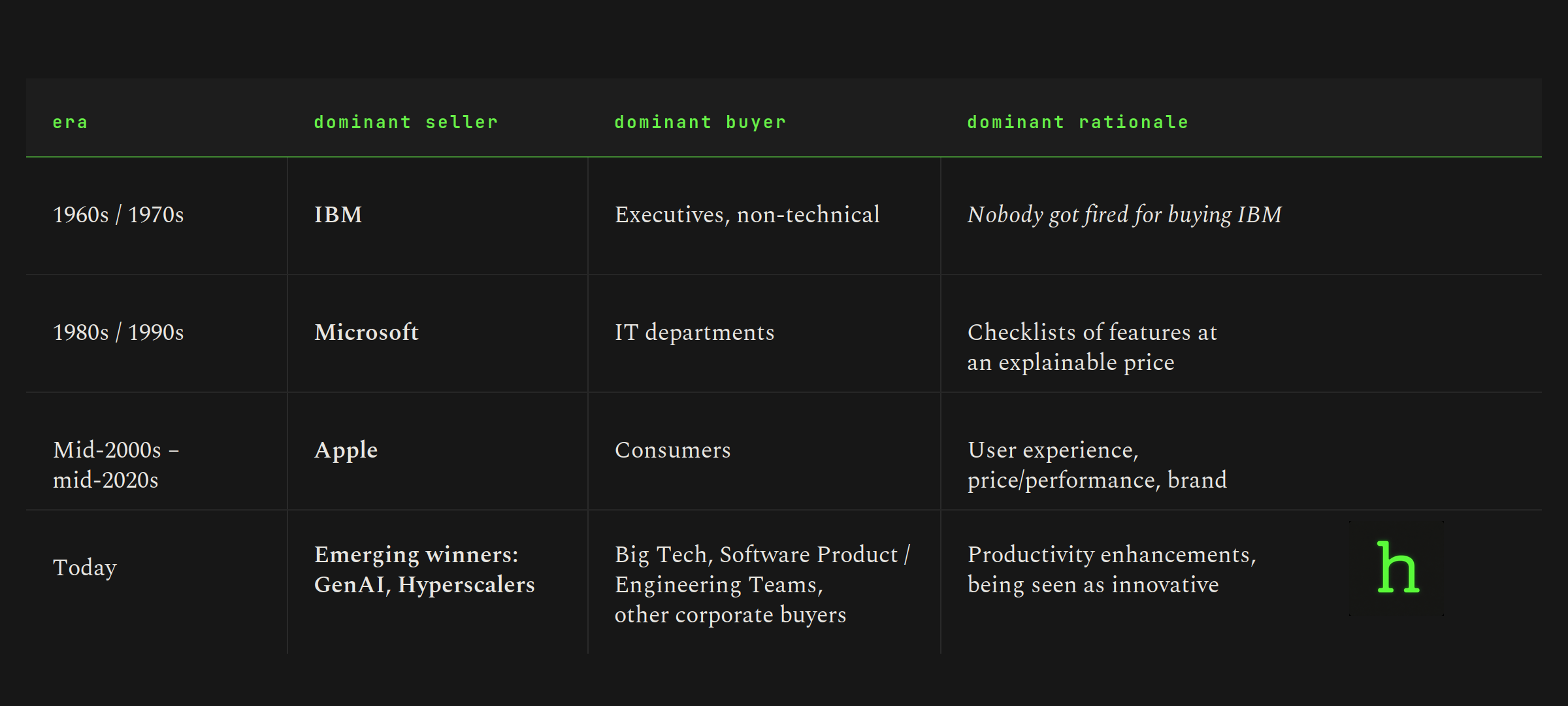
Apple and Microsoft are still in pretty good positions relative to their respective markets and buyers; but for purposes of this story, I’m happy to entertain the idea that the GenAI companies and large hyperscalers have become the dominant sellers in this market era. They are certainly the most talked-about by the tech-and-business media-industrial complex. (Including little ol’ me).
I love great products that feel well-made and well-considered; and that’s almost never been the driving force at Microsoft. (My favorite IT dad joke is “if Microsoft made a product that didn’t suck, it would be a vacuum cleaner.”) But Microsoft has been extremely good at pleasing their target buyers: IT departments who are so often over budget and under-staffed. If it’s explainable to the CFO and easy to manage, it wins. Consumers (and people of taste) are simply not part of the program.
This is why they lost to Apple in the war for the next era: actual users chose the iPod and then the iPhone, much to Steve Ballmer’s bewilderment. These customers didn’t mind paying more for a better product. Apple’s care for and vertical integration of not only the physical product, but of the user experience, were now the defining benefits for the target buyer. Mediocre, half-implemented features that probably never even sniffed a designer on their way to market — those were no longer enough to win.
What is therefore interesting about the current era is that the buyer profile is shifting again. It’s closer to the old “IT department,” but with a broader set of stakeholders. IT still needs to coordinate, govern, secure, and sign off, but the Gen AI purchase is often being driven by other teams: software development, marketing, sales, and others. This generation of buyers has a lot of experience with technology in the workplace, and exposure to Gen AI products as consumers, so they are very comfortable pursuing these tools. (And we’ve learned they’ll use them insecurely and without permission if we stand in their way).
If Microsoft can communicate a clear AI value proposition (Are they competitors or friends with OpenAI? Frenemies? Agnostic? Is “Copilot” just 2020s-speak for “Clippy”?), they are the biggest potential beneficiaries of the SaaS-pocalypse. Microsoft knows how to create value for corporate buyers, and most buyers I know would rather get their just-good-enough SaaS software from one place / on a single bill. (The rise of Microsoft Teams is the canonical business case for this). If they can adapt to the broader stakeholder set on the customer side, and integrate the proper amount of AI, Microsoft can be very successful at this game.
“I can just whip that up with Claude,” you’re saying. Yeah, maybe. Maybe you, dear reader of this post, can. But Microsoft can do a lot here.
But what about Apple, you’re asking? Apple needs to deliver AI capabilities that are valuable to their core buyers: consumers of taste, and creatives. Their best AI I can see with my own eyes is in the Photos app and isn’t even really “AI” branded: they’ve made it really easy to find what I’m looking for with search. The challenge here for Apple is going to be creating really powerful tools that don’t allow users to damage the Apple brand. Genmoji and Image Playground both show what can happen when they prioritize brand considerations over utility. They need to find ways to manage these trade-offs, or obviate them by just making AI work transparently.
The smartest thing Apple has done is wait out the capital expenditures boom. Yes, a lot of capacity-building is necessary right now, but the net present value of these investments in this generation of GPUs and data centers is probably pretty low. The parallel story that leaps to mind from dotcom 1.0 is Global Crossing. The investment thesis was eventually correct; but the ROI on these specific investments was horrendous. The Mag 7 today have enough capital to blow a ton of it on capacity; but bets of the size they’re making won’t pay off for more than one or two of them — if that.
But “waiting out capital expenditure bubbles,” while wise, is not a strategy. What will matter is what Apple does after the bubble pops.
Now, who would I not want to be for the next 5 years? Salesforce. “I can just whip that up with Claude,” indeed. Let’s see, Salesforce’s moat is workflow lock-in, and workflow is exactly what agents dissolve. Pretty good use case for Claude and a pot of coffee.